
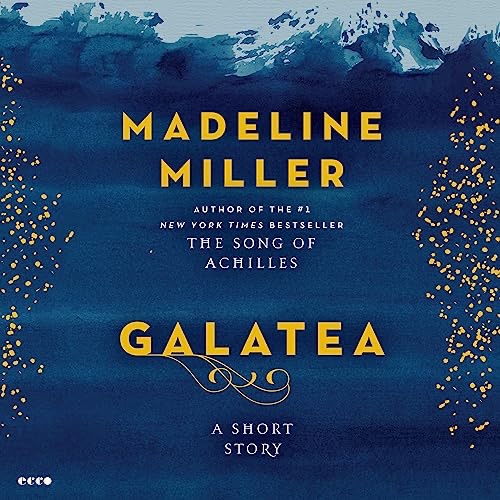
After reading “Mestra“, I made it a point to seek out the books and stories Madeline Miller had written that I had not yet read and move them to the top of my TBR pile. My first stop was her short story “Galatea”.
The story is Miller’s reimagining of the myth of Pygmalion, a sculptor who becomes so disillusioned with women that he chooses a life of celibacy. Yet despite his disdain for real women, he remains obsessed with beauty. Determined to create his vision of perfection, he sculpts a statue of the “ideal woman.” He soon falls deeply in love with his creation and prays to the gods to bring her to life. The gods grant his wish, and the two marry and have a daughter.
What Miller does so brilliantly in her retellings is weave ancient myths together with modern perspectives. In “Galatea,” she reexamines this familiar story through the eyes of the woman who was once a statue. The result is a sharp and thought-provoking feminist retelling that gives voice to a character who, in the original myth, has little say in her own story.
Viewing the myth from this angle reveals so much about beauty, control, autonomy, and the expectations placed upon women. It is a reminder that every story changes when we hear it from the other side. A tale that might once have seemed romantic becomes something far more complex when told by the person expected to fulfill someone else’s ideal.
As I have said repeatedly, Miller is the reason I understand anything about Greek mythology. She has a gift for making these ancient stories feel immediate, relevant, and deeply human. Honestly, she could publish the grocery list of the gods, and I would be first in line to buy a copy.
The audiobook’s narration adds an extra layer of intimacy to Galatea’s perspective, making her voice feel personal. Given the story’s first-person viewpoint, hearing Galatea tell her own story only strengthens the emotional impact of Miller’s retelling.
Short fiction is something I wish were more popular than it is, and Galatea is a perfect example of why the form deserves more attention. In only a few pages, Miller creates a compelling character, reimagines an ancient myth, and explores ideas that transcend time. It is proof that in the hands of a talented writer, a great deal can be said with very little.
Until next time,
Lisa


